2014 has been a great year for Van Ons. In February, the team, which had grown considerably, moved into the new office and we were able to welcome Decathlon, Joolz and the New York Media Group* as new clients. Jerry Helmers wrote in his column about the founders in De Telegraaf. We gave up presentations WordCamp.
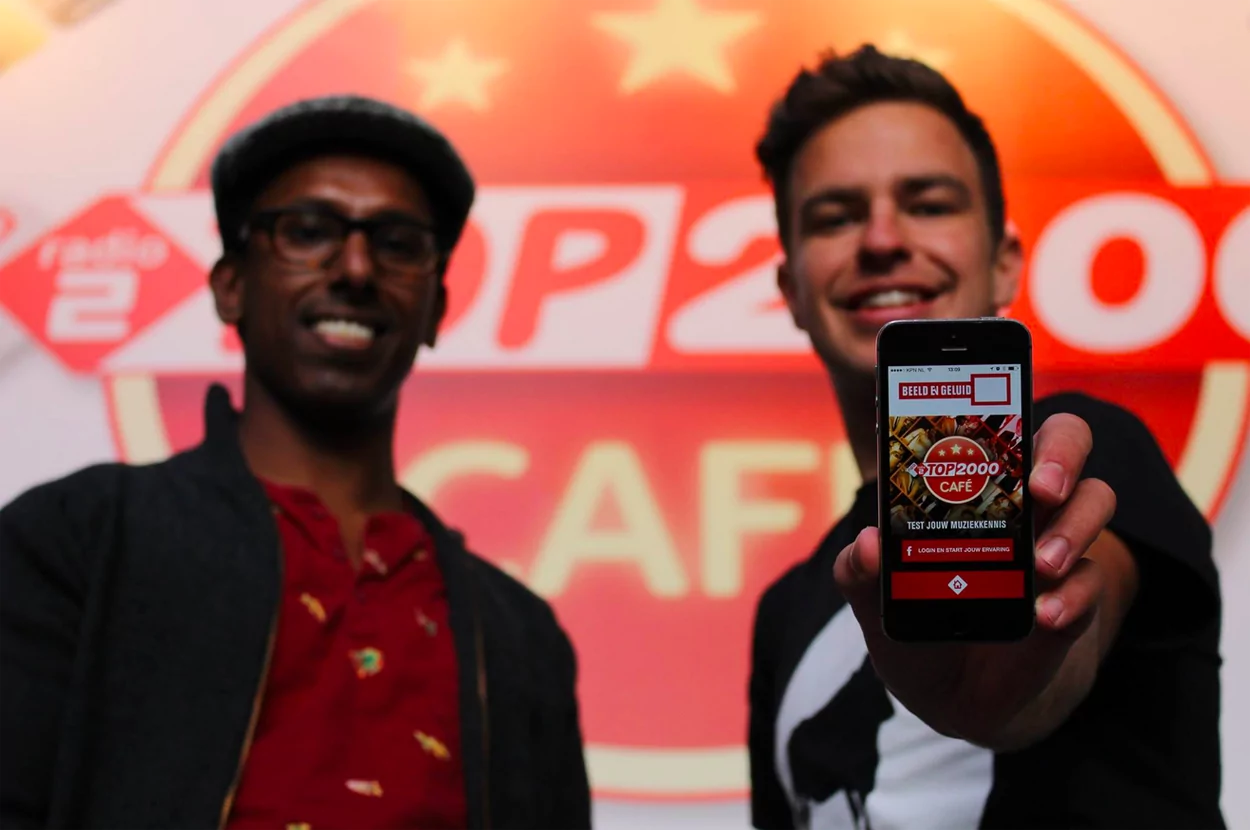
In addition to realizing WordPress websites, links and applications, we also experimented and built with other techniques. This month, in collaboration with Beeld en Geluid, we launched the iBeacon application for the Top 2000. For the Zaanse Schans, we used data feeds from WordPress for digital screens. For Exact Online, there were applications that allow WordPress to be linked to the accounting program. These were included in the Exact Online App Store in several European countries.
The Van Us Team would like to wish everyone happy holidays and a successful new year!
* And a thousand and one customers. Also celebrities and the largest newspaper and magazine publishers in the Netherlands, by the way, but we cannot say anything further about that.
That iBeacon technology (comparable to a GPS signal, but then especially accurate indoors) is at #7 in this list 'Mobile trends for 2015' by Fonk. We estimate the deployability higher if more parties – as Van Ons has shown – talk and write less and mainly do, that first (test) case is like the first sheep over the dam…
These are 5 trends that we expect in 2015 for websites and applications that our existing and future customers will encounter.
5. More open source (also in government!)
We could include this 'trend' in a comparable list every year, so perhaps not really a trend. Yet we increasingly feel (and hear) within large organizations the cry for open source and the decisiveness to actually implement it. Even if certain software does not have all the functionalities that an enterprise version offers, it can be set up faster and often cheaper.
In addition to tight planning and a well-defined budget, there is something else very important with open source solutions (and the party you choose for them): flexibility! Think of it as the difference between a speedboat and an oil tanker. If new wishes unexpectedly arise during a project or if it is not yet 100% compliant, open source makes it possible to make adjustments and refinements.

4. To test? Optimize
“A website is never finished”you sometimes hear. Van Ons is happy to ensure that a site is finished and that there is room for further development. If there is no longer any attention for a site after delivery, you are doing yourself a disservice. Functions can always be better or nicer. More goal-oriented. More effective. The most important thing is that the product provides a service to (future) customers or members or patients or users and is usable.
So test! And optimize. This could be for search engines, but also keep the focus on the end user. Show flexibility,. If something doesn't work for the user, a better solution must be found.
A continuous process because if you stop, you are actually saying that the end user stands still and never has new wishes.
We were continuously working for Joolz and the New York Media Group in 2014. Improvements in design, user-friendliness and sometimes also technical SEO have ensured that the sites are faster, easier to manage and also display well on mobile phones.
In the case of Joolz, which sells striking strollers, online sales have clearly increased.

3. Better WEB design!
With the emphasis on web. The time that someone who can draw a bit or who divides newspaper columns for his work (all respect for these people) also designs a site (whether or not for a neighbor or second cousin) is over, or should be over. Professional organizations deserve a professional web design. In line with the house style of course, but focused on the medium. This list of 15 web design trends from Emerce is a good indication of the possibilities and is full of elements that we fortunately see more and more often with our customers.
For example, AG5 had a strikingly fresh design in HTML developed by the German Upstruct. Fully responsive and this made the technical realization fast and goal-oriented. This client granted himself the advantage of knowing from minute 1 what was coming.
Tip: involve a technical party in the design process. Then technical knowledge and a designer's eye really merge, which should turn out well!

2. All-inclusive web development
In recent years it was common to make everything work well in Internet Explorer 8 (2009). In the meantime, more and more customers and agencies (and banks, for example) are letting go of this, but you can count on a whole range of other things that need to be arranged properly when building or expanding a new website. Think of:
– Responsive design. A design that is developed for mobile, tablet and (increasingly larger) desktop screens. This year, for example, we took care of the transition of Dokter Leenarts to a fully responsive and WooCommerce optimized theme.
– Retina support so that logos, icons and fonts also look beautiful on crystal clear Apple screens.
– SEO. WordPress in collaboration with the Yoast SEO Plugin already does this very well, but additional advice about writing content, using sitemaps and the correct redirects is often required. A few actions in the settings of the Yoast plugin and in webmaster tools of the best-known search engines also ensure that the technology does not hinder success in the search results.
This year we assisted Hallo Roos and BNA (discussed in the point below) with this.

1. Links
In 2015, it is unnecessary for information to be locked up in one system. It is increasingly desirable to link the new website (or app or platform) to various systems. This can be accounting software or a planning tool, for example. Complete HRM or CRM systems based on WordPress are sometimes requested. Van Ons can always link professional tools with well-documented APIs (what is that?) to WordPress. However, we always ask the central question of what the end goal is, because each tool must be used where it is best at.
We often advise against WooCommerce – a plugin that allows you to expand WordPress with webshop functionalities – if the intention is to become the next Bol.com or Amazon. The quantity of products is not so much the challenge (a common misconception), but it is not the best tool for this end goal. Managing all your leads, associated addresses and contact moments in WordPress is possible, but a specialized CRM package may be better.
For webshops we saw the problem that often separate bookkeeping arises. That of the webshop software (WooCommerce, or for example Shopify) and the 'offline' sales. ConnectPush was set up from the demand for that connection.
The new website of the Association of Architectural Firms (BNA) that we developed is a good example. Course and contact details come from AFAS, for example, where all member information is already stored. Registering for a course will soon be done via a separate tool that also connects to AFAS. The best tool has been selected for each problem.

Epilogue
We would also like to take all these tips to heart. At the beginning of 2015 we will introduce a new website that better highlights all our work and we will introduce a new corporate identity. Until then!